An incomplete rights chain
Composition and master are two different products with two different splits. Having one cleared and not the other blocks you exactly as much as having neither.
 Gustavo CerqueirasAltus Music
Film · TV series · Documentary · Advertising · Sonic branding
The hard part about music on a project isn't finding it. It's being allowed to use it.
I write and produce the music, and I hand over the rights chain that lets you air it: an assignment contract with explicit territory, media and term, sync licence, cue sheet, split sheet and full metadata.
One point of contact. One invoice. No legal surprise six months later.
Almost every music problem on an audiovisual project shows up after delivery, once it is expensive to fix: the campaign expands into a market the licence never covered, the collecting society asks for a cue sheet nobody filled in, or the master turns out to sit with a third party who signed nothing.
Composition and master are two different products with two different splits. Having one cleared and not the other blocks you exactly as much as having neither.
Composer, studio, publisher, label, agency. Five conversations, five calendars and five invoices for a single 30-second cut.
With no split sheet, no cue sheet and no identifiers, the work exists but is invisible: it isn't registered, isn't tracked and doesn't pay out. The cost surfaces months later.
Every piece comes with its alternative version. That isn't a stylistic flourish — it's how I work. I never present a single direction, because comparing two is faster for the team than correcting one.
How a scene is supported without being covered: theme, development and sync point.
A brand piece with its sonic logo, resolved across the durations the media plan actually needs.
Ethno-jazz: the rhythms of the indigenous peoples of the Southern Cone crossed with jazz harmony and improvisation. The signature you won't find in a library.
Six services, available separately or as a single music line under one point of responsibility.
Full score: main theme, dramatic development and sync points, with live players when the project calls for it.
Bespoke music for a commercial, branded content or social cut, delivered in every duration and channel the plan requires.
Full audio branding: the sonic logo and the whole system that makes it usable at every touchpoint.
For when the job isn't to write music but to pick the right one and be able to use it. Search, negotiation and clearance of existing repertoire.
The entire music line of a project under one point of responsibility, from creative brief to documented delivery.
The part almost nobody offers alongside the music. I have taught publishing for years and apply exactly what I teach.
If you're assessing repertoire or looking for a composer, this is the information that normally takes three emails. Here it is up front.
split sheet · cue sheet in the society's format · work certificate · written human-authorship declaration.IPI per rights holder, ISWC for the work and ISRC for the recording, plus the society where it is registered.No schedule surprises and no "here's something, see if you like it" phase. Every step has a concrete deliverable and a date.
A 30-minute conversation. I come out of it with references, tone, durations, sync points and — above all — the real scope of the grant you're going to need.
30 minTwo distinct proposals, not one. Comparing two directions is faster and cheaper than correcting one nobody dares touch any more.
48-72 hRevisions on the chosen route, with the number of rounds agreed in writing from the quote onwards.
AgreedArrangement, musical direction, recording, mix and master. Live players when the project asks for it and the budget allows.
Per projectMaster, stems, every version and the complete rights folder. The project closes legally as well as sonically.
DocumentedIncluded in every commission — not an add-on, not a separate budget line. It's the difference between handing over an audio file and handing over a usable asset.
WAV 24/48, stems by family, instrumental and TV track.
Durations by channel and social edits, delivered together.
With territory, media and term written explicitly.
For the work and the master, with no gap between the two.
Work shares signed by everyone involved.
In the format the relevant collecting society requires.
Writers, publishers, shares, IPI, ISWC and ISRC.
Human authorship declared in writing and traceable.
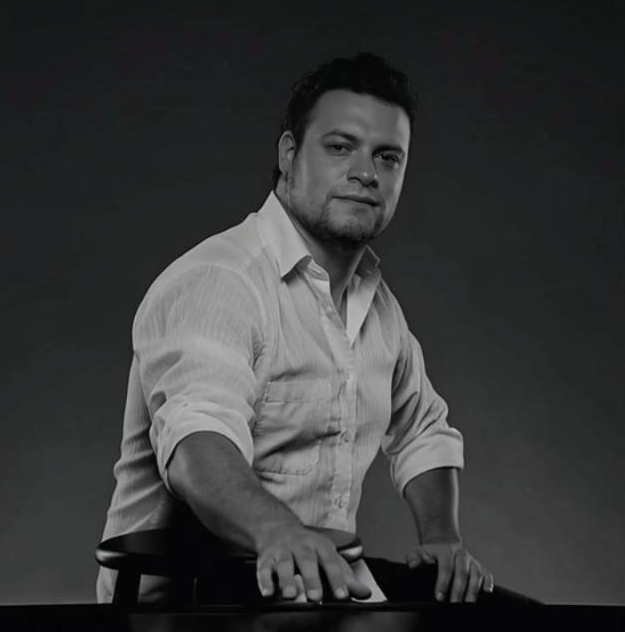
I scored the series "No abras la puerta" (TVN) and "Príncipes de Barrio" (Canal 13), and created the corporate sonic identity of TVN, Chile's public broadcaster. I have produced and played for artists including Kudai, Palmenia Pizarro and Andrés de León, and collaborated with Rod González (Die Ärzte).
As a pianist and composer I won the 2017 Pulsar Award for Best Fusion Artist with Holman Trío, releasing six records and touring the United States, Canada, South Korea, Mexico, Colombia, Brazil, Uruguay, Argentina and Spain, with shows at Lincoln Center in New York and the Montreal Jazz Festival.
And there is a second half to my work that isn't artistic: rights management. I teach publishing, licensing and sync — assignments, split sheets, cue sheets, metadata, master rights versus composition rights. Which is why, when I deliver music, I deliver the paperwork that lets you use it.
And if yours isn't here, write to me: answering one specific question beats sending a deck.
A composer writes new music for the project. A music supervisor decides what should be heard and resolves how to use it legally: sourcing repertoire, negotiating sync licences, briefing the composer and closing the rights paperwork. I do both, so on the same project I can score it, licence existing repertoire, or combine the two depending on what suits the piece and the budget.
On my own work, composition and master sit with a single controlling party. That means one negotiation and one signature to authorise the use — no publisher, label or featured artist surfacing halfway through clearance with a veto and a new fee.
Three things, explicitly: territory, media and term. On top of that, composition rights (writer and publisher) and master rights have to be resolved separately, because they are different products with different splits. If any of those pieces is missing, the broadcast is exposed.
You can, but read the whole licence. Many libraries cap territory, media or term, and almost none give you exclusivity — the same cue may be running in a competitor's campaign. If the campaign expands or runs longer, the licence stops covering you and you renegotiate from a weaker position. Original music removes that and builds an asset the brand actually owns.
It depends mostly on the scope of the grant: Spain for 12 months is not the same as EMEA in perpetuity. I always quote in three tiers so the team can compare scope against cost before deciding, with the rights fee separated from the production fee — which is what lets you defend the line internally.
A sonic logo and the full system around it: long, short, on-hold, app, event and social versions, plus the sound usage manual that sets out when and how each one is used so the brand sounds consistent across every touchpoint. I created the corporate sonic identity of TVN, Chile's public broadcaster.
Two distinct creative routes within 48-72 hours of the brief. From the chosen route: revisions, production and final delivery to the project schedule. Timings and revision rounds are written into the quote, not negotiated halfway through.
Yes. Based in Madrid, working remotely across EMEA and Latin America, with working knowledge of Ibero-American co-production and of how a work is registered across different collecting societies — which is usually where multi-territory projects break.
With the release date, the intended scope and one sentence on tone, I can tell you the same day whether it fits and what each tier would cost.
If you'd rather see the material before talking: write and I'll send the 90-second reel, the credentials PDF and a sample three-tier quote.